What most visitors miss
The typical Petra visit follows a single line: through the Siq, to the Treasury, up to the monastery, back. It is spectacular. But the archaeological zone extends over 264 square kilometres and contains hundreds of tomb facades, rock-cut temples, processional ways, high places and ancient water systems that the main trail never reaches.
A guide who knows Petra's back country changes the experience entirely. The ridgelines above the main valley reveal the city's true scale — from altitude, you can see how the Nabataeans engineered a metropolis of 30,000 people in a mountain fastness with no natural water source, through a system of channels, dams and cisterns that collected every drop of rain.
The back route to the Monastery
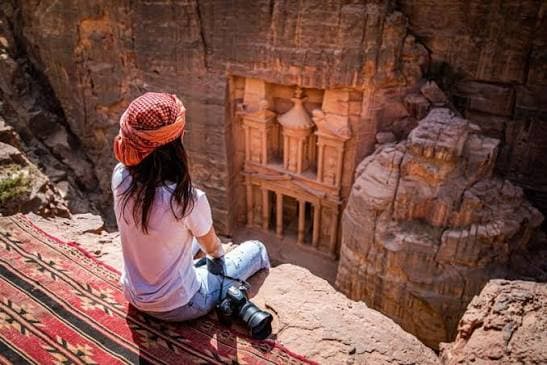
The standard approach to the Monastery (Ad-Deir) climbs 800 steps from the main street. The back route, starting from Little Petra (Siq al-Barid, 7 km north of the main Petra entrance), descends through the Nabataean agricultural terraces, crosses a ridge, and arrives at the Monastery from above — approaching the facade from the mountain rather than from the steps.
This 3–4 hour guided hike is outstanding: you traverse empty landscape, encounter almost no other visitors, pass unexcavated tomb facades and carved niches, and arrive at the Monastery for a different perspective entirely. A guide is mandatory for this route; it is not marked and the terrain is complex.
Qasr al-Bint and the ancient city centre
Most visitors reach the Treasury and consider Petra done. But a further 2 km walk reaches Qasr al-Bint, the only freestanding temple in Petra, dedicated to the Nabataean god Dushara and standing 23 metres high. The Colonnaded Street running in front of it was Petra's main commercial artery, lined with market stalls and public buildings.
The Great Temple — a massive ceremonial complex that would have rivalled anything in the Roman world — stands behind the Colonnaded Street, excavated by Brown University since 1993. The Garden Triclinium and the Painted House, both off the unmapped trails, preserve vivid fresco fragments.
Planning a back-trail day
Back-trail hikes at Petra should be planned with a licensed Bdul guide (the Bdul Bedouin are the traditional inhabitants of Petra and the best interpreters of its landscape). Al Maqsad arranges private Bdul guides for all trail combinations.
Bring a full water supply (3+ litres per person), sun protection, sturdy shoes and a hat. The back trails involve scrambling and some exposure — they are moderately demanding but not technical. The best time is October to April; summer heat makes long back-trail days dangerous.