What makes Jerash extraordinary
Jerash is ancient Gerasa, one of the ten cities of the Roman Decapolis league. Unlike many classical sites reduced to scattered fragments, Jerash survived largely intact beneath later settlement — its colonnaded Cardo Maximus, two theatres, temples, baths and a hippodrome are all visible and, in many cases, still standing.
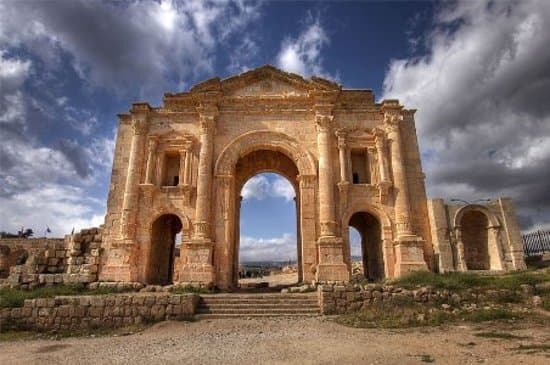
The Hadrian's Arch at the city's southern entrance is a 21-metre triumphal gateway built for the emperor's visit in 129 AD. Walking through it still feels ceremonial. The Oval Forum — an elliptical plaza edged by 56 Ionic columns — is one of the most photographed ancient spaces in the Middle East.
Highlights inside the site
The South Theatre seats 3,000 and its acoustics remain so precise that performers still use it for the annual Jerash Festival of Culture and Arts. The Temple of Artemis, patroness of Jerash, offers columns whose capitals visibly wobble in the wind — demonstrating the sophisticated jointing that has kept them standing for two millennia.
The Nymphaeum — a grand second-century fountain house — retains fragments of carved dolphins and gilded niches. The Cardo Maximus's original chariot ruts are still carved into the limestone paving. Every hundred metres reveals something new.
Practical tips and timing
Jerash is best visited in the morning: cooler, less crowded, and the low light brings out the honey colour of the limestone. Give yourself at least two hours, ideally three. Comfortable shoes and a light layer for shade are essential.
The Jordan Pass includes Jerash entry and saves money if you are visiting multiple sites. Licensed guides at the gate are knowledgeable and worth the modest fee — they bring the ruins to life in ways a guidebook cannot.
Combining Jerash with other sites
Jerash is 45 minutes north of Amman and fits naturally into a morning before returning to the capital. It pairs beautifully with Ajloun Castle, another 30 minutes west — the crusader fortress perched over pine forest makes a perfect afternoon complement.
For those driving north, Umm Qais on the Syrian border is a two-hour drive and offers a dramatically different Roman landscape with views over three countries. Al Maqsad designs day tours combining all three.